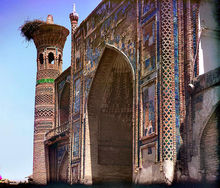
madrasa etiketine sahip kayıtlar gösteriliyor. Tüm kayıtları göster

1 Temmuz 2007 Pazar

What is Madrasa?


The word "madrasah" also exists in many Arabic-influenced languages such as Urdu, Hindi, Farsi, Turkish, Kurdish, Indonesian, Malaysian and Bosnian. In the Arabic language, the word مدرسة implies no sense other than that which the word school represents in the English language, such as private, public or parochial school, as well as for any primary or secondary school whether Muslim, non-Muslim or secular. Unlike the understanding of the word school in British English, the word madrasah refers in American English to a university-level or post-graduate Islamic school. The correct Arabic word for a university, however, is Jami'ah. The Hebrew cognate "midrasha" also connotes the meaning of a place of learning. There are some madrasah-like institutions also in North America and in Europe. A Madrasah complex in The Gambia A typical madrasah usually offers two courses of study: a "hifz" course; that is memorisation of the Qur'an (the person who commits the entire Qur'an to memory is called a hafiz); and an 'alim course leading the candidate to become an accepted scholar in the community. A regular curriculum includes courses in Arabic, Tafsir (Qur'anic interpretation), shari'ah (Islamic law), Hadith (recorded sayings and deeds of Prophet Muhammad), Mantiq (logic), and Muslim History. Depending on the educational demands, some madrasahs also offer additional advanced courses in Arabic literature, English, and other foreign languages as well as science and world history.

People of all ages attend, and many often move on to becoming imams. The certificate of an 'alim' for example, requires approximately twelve years of study. A good number of the huffaz (plural of hafiz) are the product of the madrasahs. The madrasahs also resemble colleges, where people take evening classes and reside in dormitories. An important function of the madrasahs is to admit orphans and poor children in order to provide them with education and training. Madrassahs may enroll female students; however, they generally study separately from the men. There are examples of all-female madrassahs.

In South Africa, madrasahs play an important role in giving after-school religious instruction to Muslim children who attend government, or private non-religious schools. However, increasing numbers of more affluent Muslim children attend full-fledged private Islamic Schools which combine secular and religious education. Among Muslims of Indian origin, madrasahs also used to provide instruction in Urdu, although this is far less common today than it used to be.

History

Enlarge picture
Madrassa Osman ef. Redžović in Visoko, Bosnia was rebuilt shortly after Bosnian war. It is now a modern school with mosque, and has plans for further expansions
Madrasahs did not exist in the early period of Islam. Their formation can probably be traced to the early Islamic custom of meeting in mosques to discuss religious issues. At this early stage, people seeking religious knowledge tended to gather around certain more knowledgable Muslims; these informal teachers later became known as the shaykhs; and these shaykhs began to hold regular religious education sessions called 'majalis'.

Established in 859, Jami'at al-Qarawiyyin (located in Al-Qarawiyyin Mosque) in the city of Fas (Fez), it is considered the oldest madrasah in the Muslim world.

During the late Abbasid period, the Seljuk vizier Nizam al-Mulk created the first major official academic institution known in history as the Nizamiyyah, based on the informal majalis (sessions of the shaykhs). Al-Mulk, who would later be murdered by the Assassins (Hashshashin), created a system of state madrasahs (in his time they were called, the Nizamiyyahs, named after him) in various Abbasid cities at the end of the 11th century.

During the rule of the Fatimid and Mamluk dynasties and their successor states in the medieval Middle East, many of the ruling elite founded madrasas through a religious endowment known as the waq'f. Not only was the madrasa a potent symbol of status but it was an effective means of transmitting wealth and status to their descendents. Especially during the Mamluk period, when only former slaves could assume power, the sons of the ruling Mamluk elite were unable to inherit. Guaranteed positions within the new madrasas thus allowed them to maintain status. Madrasas built in this period include the Mosque-Madrassa of Sultan Hassan in Cairo.

Madrasahs in South Asia

Madrasahs in India

In India, there are around 30,000 operating madrasahs. It is assumed that a majority of these schools follow the Deobandi school of thought. One of the most famous of these is Darul Uloom Deoband (Dar al-'Ulum), located in Deoband, a small town located in the Indian state Uttar Pradesh. In 1986, the Indian government expedited a project to modernize madrasahs by introducing other subjects including science, mathematics, English, and Hindi. Madrasah education is always provided for free. As a result, the madrasahs often have a multifarious student enrollment, including some Hindus and Christians.

Madrasahs in Pakistan

There are more than 10,000 madrasahs currently (as of 1998?) operating in Pakistan. It is estimated that one to two million children are enrolled in madrasahs. Some media reports say that only 0.3 percent of Pakistani school age children are enrolled in traditional madrasahs. This is according to Pakistan's 1998 Population Census The World Bank Group. The 1998 Population Census found only 150,000 children. Orphans, migrants, and part-time students may explain the discrepancy. Regardless, percentage wise, the madrasah enrollment is relatively insignificant. There has been considerable intellectual disagreement about the linkages of madrassahs to conflict in Pakistan. A study conducted in 2005 by Saleem Ali for the United States Institute of Peace attempts to clarify some of these concerns by providing a detailed empirical comparison of rural and urban madrassahs (currently this study is being updpated and expanded as a book (expected to be completed in 2007), though an earlier draft is available online . The project also included a web video on such schools titled Children of Faith.

25 Haziran 2007 Pazartesi

House of Osman

The "Ottoman dynasty" (c. 1290–1922) or as an institution "House of Osman" was unprecedented and unequaled in the Islamic world for its size and duration. The Ottoman sultan, pâdişâh or "lord of kings", served as the empire's sole regent and was considered to be the embodiment of its government, though he did not always exercise complete control.

Throughout Ottoman history, however — despite the supreme de jure authority of the sultans and the occasional exercise of de facto authority by Grand Viziers — there were many instances in which local governors acted independently, and even in opposition to the ruler. On eleven occasions, the sultan was deposed because he was perceived by his enemies as a threat to the state. New sultans were always chosen from among the sons of the previous sultan, but there was a strong educational system in place that was geared towards eliminating the unfit and establishing support amongst the ruling elite for the son before he was actually crowned. There were only two attempts in the whole of Ottoman history to unseat the ruling Osmanlı dynasty, both failures, which is suggestive of a political system which for an extended period was able to manage its revolutions without unnecessary instability.

After the dissolution of the empire, the new republic abolished the Caliphate and Sultanate and declared the Ottoman Dynasty as persona non grata of Turkey. Fifty years later, in 1974, the Grand National Assembly of Turkey granted descendants of the former dynasty the right to acquire Turkish citizenship. The current head of the House of Osman is Ertuğrul Osman V living in New York City.

…the Ottoman family was ethnically Turkish in its origins, as were some of its supporters and subjects. But … the dynasty immediately lost this "Turkish" ethnic identification through intermarriage with many different ethnicities. As for a "Turkish empire", state power relied on a similarly heterogeneous mix of peoples. The Ottoman empire succeeded because it incorporated the energies of the vastly varied peoples it encountered, quickly transcending its roots in the Turkish nomadic migrations from Central Asia into the Middle East.

Imperial Harem

Coffee delight at the Harem

Coffee delight at the Harem

The Harem was one of the most important powers of the Ottoman court. It was ruled by the Valide Sultan (also known as the Baş Kadın, or "Chief Lady"), mother of the reigning sultan, who held supreme power over the Harem and thus a powerful position in the court. On occasion, the Valide Sultan would become involved in state politics and through her influence could diminish the power and position of the sultan. For a period of time beginning in the 16th century and extending into the 17th, the women of the Harem effectively controlled the state in what was termed the "Sultanate of Women" (Kadınlar Saltanatı).

Harem of Topkapı Palace


Harem of Topkapı Palace

The harem had its own internal organization and order of formulating policies. Beneath the Valide Sultan in the hierarchy was the Haseki Sultan, the mother of the sultan's first-born son, who had the best chance of becoming the next Valide Sultan. The sultan also had four other official wives, who were each called Haseki Kadın. Next in rank below the sultan's wives were his eight favourite concubines (ikbâls or hâs odalıks), and then the other concubines whom the sultan favoured and who were termed gözde. Next in rank were the concubines of other court officials. Pupils (acemî) and novices (câriye or şâhgird) were younger women who were either waiting to be married off to someone or who had not yet graduated out of the Harem School.

Palace schools

"Palace schools" were not a single track but in two. First one was the Madrasa (Ottoman Turkish: Medrese) for the Muslims, which educated the scholars and the state officials in accordance with Islamic tradition. The financial burden of the Medrese was covered by vakifs, which gave a popular chance to children of poor families in changing their life by moving to higher social levels and income. Second track was a free-boarding school for the Christians the Enderûn, which recruited annual 3,000 students from Christian young males between 8 and 20 years old which come from one in forty families among the communities settled in Rumelia and/or the Balkans, a process named Devshirmeh (Devşirme). Orphans, single child, married boys, the Jews, Russians, shepherd's sons were exempted. Ottomans have been fairly successful in this trans- [or forced] culturation of students, which many statesmen were products of this process. This system functioned strictly for bureaucratic purposes, (ideally) the graduates were permanently devoted to government service and had no interest in forming relations with lower social groups. The incoming students were called the inner boys (Ottoman Turkish:iç oglanlar). It took seven years of professional development to graduate. The apprenticeship began with working in the Sultan's services; then mastering natural and Islamic sciences (formal education); and the last stage was developing their physical fitnesses and acquiring some vocational or artistic skills. It is reported by Madeline Zilfi that European visitors of the time commented "In making appointments, Sultan pays no regard to any pretensions on the score of wealth or rank. It is by merits that man rise..Among the Turks, honors, high posts and Judgeships are rewards of great ability and good service".

Click for Madrasas

Click for Enderun schools

Click for Ulema